
Patience is a virtue often lost in sports.
The fact that athletic events are decided by wins and losses frequently produces either/or thinking; A team is great or terrible. A coach is a genius or a dunce. Sports are not given to nuance. Consider what has happened so far this season for the WVU football team:
The come-from-behind win over Pitt sent a sellout crowd into a wild celebration and gave Mountaineer fans everywhere hope for the future. Coach Rich Rodriguez at least partially eclipsed the shattering loss to the Panthers 18 years earlier.
The new era had a strong foothold.
But the subsequent losses to Kansas and Utah were cold reminders of just how far Mountaineer football must travel to even be competitive. Now WVU faces a short week and a road game in a difficult environment against a ranked BYU that is favored by nearly three touchdowns.
Five games in, there is enough evidence to make even the most optimistic Mountaineer fan confront the reality that Rodriguez’s first year back will be marked by the disappointment of a losing record.
WVU Director of Athletics Wren Baker remains undeterred. He is not given to the emotional trappings of fandom. His tenure has been marked by rational and thoughtful decision making rather than unrestrained mood swings. He still believes Rodriguez and company are going to build a program the right way.
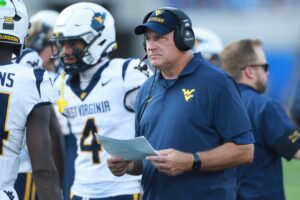
What exactly is “the right way” in this new era of college sports? That rests on how coaches combine traditional recruiting of high school athletes with smart portal decisions and efficient use of revenue share money combined with NIL opportunities.
WVU Athletics does not share specifics about rev share, but it’s believed that next season football will be able to combine the lion’s share of the $21 million available with a pot of money that was not spent this season. Again, we don’t know the exact numbers, but we do know that football did not max out this season on rev share money it had available.
Baker is also conscious of the struggles typically associated with first year head coaches, including those adapting to the changing landscape. He points to Arizona State Coach Kenny Dillingham who, during his first year in 2023 when NIL really took hold, went 3-9. The following year, new Arizona Coach Brent Brennan had a 4-8 record.
Pre-NIL and revenue sharing, Iowa State Coach Matt Campbell was 3-9 his first year in 2016. Kansas Coach Lance Leipold was 2-10 in his inaugural season of 2021. Dave Aranda was 2-7 in the Covid-shorted season of 2020, his first year at Baylor. In 2024, Houston’s Willie Fritz was 4-8.
None of this is intended to make excuses for Rich Rod and company. He and his staff, and now many of his players, are paid to do a job. The expectation of that job is to produce a football team that is—at the least—competitive in the Big 12 and at some point can compete for a league title.
How long will that take? How long will Mountaineer Nation wait to see more positive results? Now with player transfer freedom, revenue sharing and NIL, the leash on coaches has shortened from five or six years to two or three.
It is said that “Patience is not the ability to wait, but the ability to keep a good attitude while waiting.” That is the challenge for Mountaineer fans, at least for this season.