
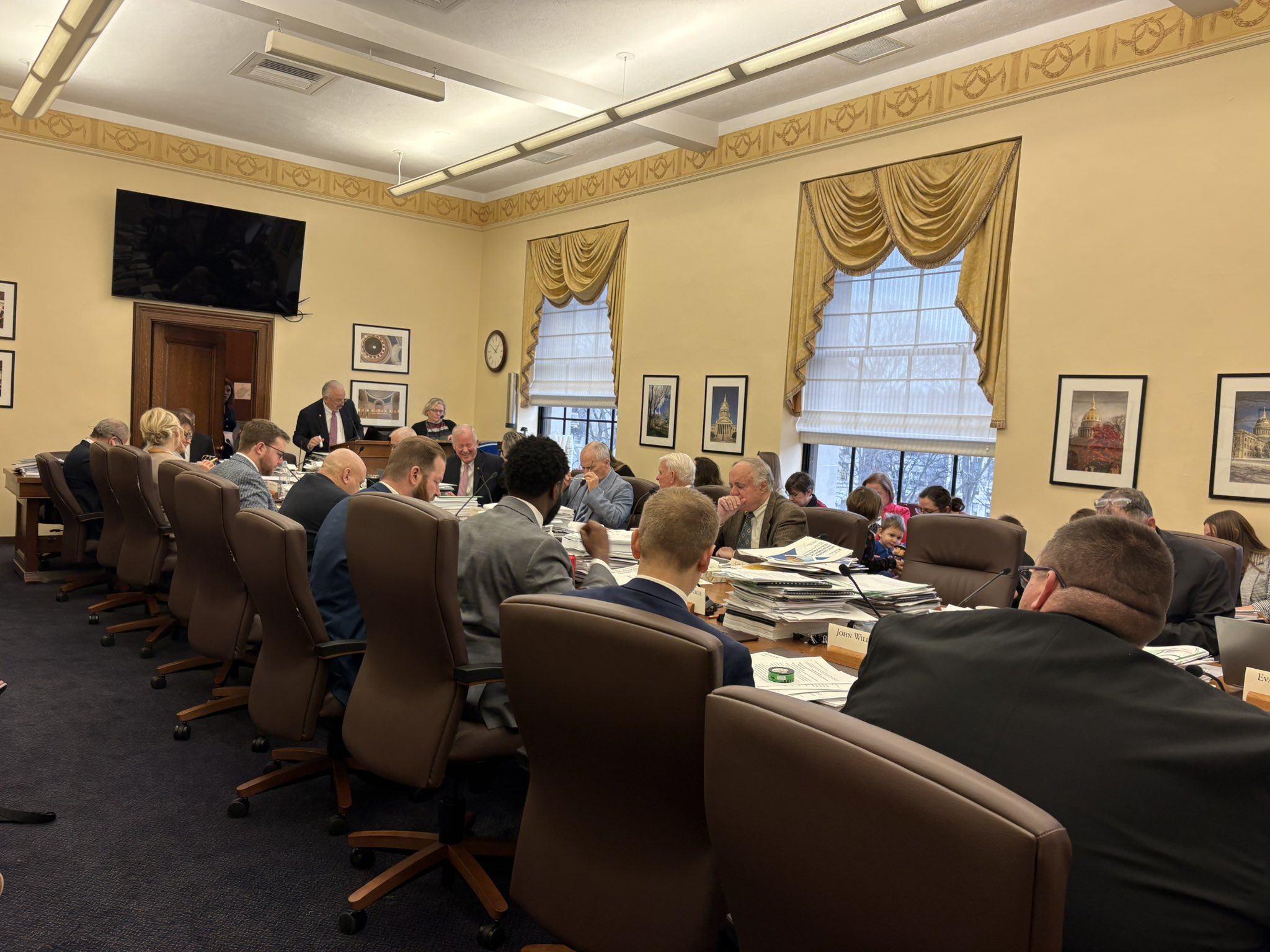
The House Finance Committee rolled out legislation aimed at refining the Hope Scholarship, which provides financial support for families seeking educational options outside the public school system.

Treasurer Larry Pack, whose office administers the Hope Scholarship, issued a statement expressing disappointment over the proposed changes. He emphasized that the proposed changes are occurring less than two weeks out from universal expansion and called the proposed changes drastic.
Pack said proposed legislation has “infused uncertainty into the program as we are about to welcome nearly 25,000 new students and families to partake. These policy decisions will only produce negative effects for our Hope families, and we are urging lawmakers to reconsider.”
As it has grown, Hope Scholarship has been a heavier and heavier budget item for the state.
Passed by the Legislature in 2021, the Hope Scholarship Act initially made the program available only to West Virginia children who were either entering kindergarten for the first time or leaving public schools for some other educational option.
However, the Act expands eligibility for the program beginning in the 2026-2027 school year to all school-age children residing in West Virginia, even if they’ve been receiving their education outside the public schools for years.

Ahead of the first year of full implementation to all families who want to use the money, the Hope Scholarship has anticipated cost of $230 million and an increased base of $127.3 million in the coming fiscal year.
“We have to control the costs at some point, just like we do on every government project we do,” said House Education Chairman Joe Statler, who is also on the finance committee.
“Cost has to be contained. We want to spend as much as it takes for education, but sky is not the limit. We don’t have all the money in the world, so we’ve got to decide how we’re going to use it.”

House Finance Chairman Vernon Criss, R-Wood, told reporters that it’s time to refine how the scholarship works.
“Our concern was, as we were watching the numbers in the three or four years that we had the program, that we were seeing an increase in the dollars involved but without bumpers or parameters or covenants or whatever you want to call them out there,” said Criss, adding that West Virginia officials examined similar programs in other states.
The House bill would change the framework of Hope in several ways:
A set funding amount of about $5,000
To this point, the Hope Scholarship amount has varied annually depending on the amount of state aid funding per pupil provided to county school boards for public school students. The scholarship amount has been $5,267.38 for the 2025-2026 school year. Right now, the scholarship amount is expected to be $5,435.62 for the 2026-2027 school year.
Starting July 1, 2026, this bill would establish a fixed annual amount for an individual recipient of $5,250.
Any future changes to the rate would be up to future legislatures.
Moves like this will help sustain the program, said House Education Chairman Joe Statler, a member of the finance committee.
“If we don’t control that cost, it can overburden it and actually go away altogether,” Statler said.
Changes allowable expenses
For families who use the Hope Scholarship for private school, allowable expenses are pretty straightforward. But for homeschool families who have individual curriculums or differing points of emphasis, a lot of flexibility has been required.
On a regular basis, the Hope Scholarship board considers general categories of educational purchase requests and gives a thumbs up or a thumbs down.
Last summer, for example, the board drew attention after denying requests for witchcraft herbs and a cauldron. At another meeting, the board had to reverse a policy and disallow purchases of tadpoles for students to use for individualized science curriculums. Purchases of lunchboxes got an OK.
The House bill would narrow the categories for allowable expenses to tuition, curriculum and technology. For instance, the bill adds a new category of technology equipment, specifically including computers and required software, but would add a factor for the “useful life” of those kinds of purchases.
“You don’t need a new computer every year,” Criss said. “You move up a grade, you don’t need a new computer.”
Several previously allowable categories would now be out: testing and prep fees, after-school or summer education programs and music equipment — plus a “catch-all” provision that allowed the Board to approve “any other qualifying expenses.”
“We don’t provide horseback riding for public school systems,” Statler said. “And we’re not saying everything is bad, but we’re just putting some limitations on it.”
Standardized testing:
This bill bumps up the requirements for student assessments to maintain eligibility.
Students in an Individualized Instruction Program must provide annual confirmation that they have either:
- taken a nationally normed standardized achievement test in reading, language, and mathematics (plus science and social studies if available for their grade level)
- taken the comprehensive statewide student growth assessments that are required for public school students
- or undergone a certified teacher review of their academic work
“The testing part was one of the big things we found that other states are doing because they want to see the value for their dollar,” Criss said.
In-state requirement for schools:
The bill explicitly restricts the types of schools that can receive scholarship funds.
The definition of a “participating school” is strictly limited to private schools located in West Virginia.
The bill adds a specific requirement for microschools, stating that tuition and fees are qualifying expenses only provided that the microschool is located in West Virginia.
To maintain eligibility for the scholarship account, a parent must provide annual proof of the student’s continued West Virginia residency.
A change in the overall funding schedule
The state funding cycle for the Hope Scholarship has often resulted in a late-summer logjam.
Right now, one half of the total annually required deposit is made no later than August 15, and the remaining half is made no later than Jan. 15.
The August 25 date has been right after state starts a new fiscal year, so that has resulted in a complicated situation for state finances.
“July, August and September are tough months for the state, and to have this great amount of money that has to go out in August is difficult from a cash flow standpoint,” Criss said.
For families buying school supplies — particularly homeschool families — the cycle often results in delayed purchases when they would normally be wanting to start the latest round of lessons.
With this bill, the program moves to a quarterly deposit schedule: August 15, Oct. 15, Jan. 15 and April 15.
Reaction already
Organizations supporting West Virginia school choice programs reacted with criticism of the proposed changes.

Americans for Prosperity-West Virginia distributed a letter to lawmakers describing the legislation as a key vote and urging a “no.”
“The House Finance Originating Bill Regarding the Hope Scholarship would wantonly and intentionally take West Virginia backwards. It represents nothing more than an attempt, by politicians who arrogantly think they know better than parents, to kick families out of school choice, limit education options, and slowly shutter the program.
“Nearly all the provisions in this legislation are designed to hurt families and students by taking away the flexibility they deserve and currently have in law. We oppose all provisions of this legislation and urge its swift defeat,” AFP-WV wrote in the memo distributed by state director Jason Huffman.

The Cardinal Institute for West Virginia Policy think tank expressed serious concern regarding proposed changes.
“Families seeking targeted remediation and relief from inadequate special education services should not be subjected to new layers of state control that mirror the system they are leaving,” said Tiffany Hoben, director of education partnerships and strategy at the Cardinal Institute.
“These restrictions are deliberately harmful to vulnerable students and fundamentally incompatible with a parent-directed program. They undermine choice, restrict flexibility, and betray the original purpose of the legislation.”

Dale Lee, co-president of the Education West Virginia teachers union, disagreed with those points.
“The idea that this bill restricts choice is absurd. All this bill does is add guardrails to provide some accountability on the program and would require West Virginia taxpayer dollars to be used in West Virginia. Parents still retain the choice in their child’s education,” Lee said.
“This bill would provide parameters to prevent the cost of this program from ballooning out of control. We applaud the House Finance Committee for safeguarding taxpayer money, while still ensuring academic freedom for families.”

Kristie Skidmore, co-president of the teachers union added that criticism of provisions like the standardized testing requirement don’t add up. “Why wouldn’t any parent want to be able to measure their child’s progress?” Skidmore said.
Statler, the education committee chairman, was bracing for an earful about the issue.
“I guarantee you, when I pull my phone out of my pocket I will already be lit up with emails for and opposed to this,” Statler said. “That’s the way it is, and they’ll go on for a day or two.”
Statler suggested the finance committee will revisit the bill as soon as Friday, potentially making changes and passing it to the full House of Delegates.
“I would predict there’s amendments coming on this originating bill before it ever gets to the floor, and then when it gets to the floor there will be all kinds of amendments,” Statler “so this bill is a long way from being settled.”