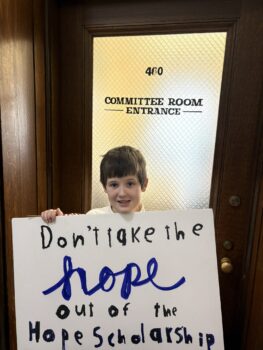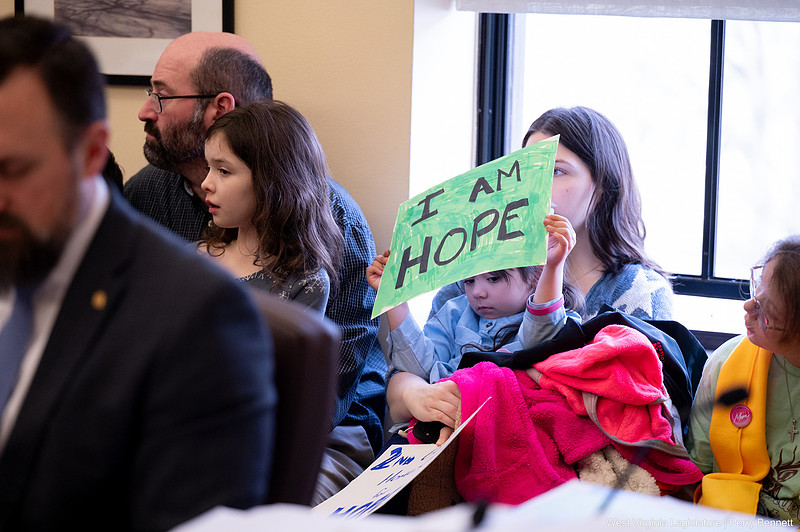
With the House Finance Committee set to take up a bill with reforms to the Hope Scholarship, families who use those state dollars packed the room to demonstrate their interest in sustaining the program as-is.
And then when the committee adjourned without taking up the bill, parents vocally expressed their displeasure.
“We’ll be back and we’ll come with more families,” said a mother who had been sitting against the far wall. “This is important for our kids. It’s important for our state. It’s important for our future.”
Another who had been standing near the chairman’s podium said, “I drove an hour after working a 12-hour shift as an RN.”
“I drove three hours from Morgantown,” another said.
One of the mothers followed up by telling any delegate who would listen, “We’re paying attention and we’re here. You can’t ignore us.”
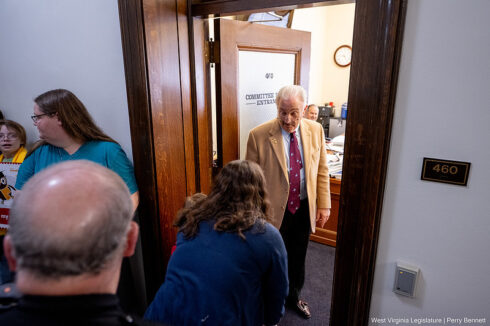
The House Finance Committee this week rolled out legislation aimed at refining the Hope Scholarship, which provides financial support for families seeking educational options outside the public school system.

House Finance Chairman Vernon Criss and the vice chairman, Delegate Clay Riley, told reporters after today’s meeting that the delay on committee discussion and a vote today was to take more time to refine it.
“Obviously there’s a lot of public interest, and sometimes if the right information is not out there it causes some concern,” said Criss, R-Wood.
“One of the things that we were trying to do here is bring in line the things that we want to provide for the Hope Scholarship so in the long term the program will survive. That’s one of the main problems to solve with where we’re at right now.”

Riley, R-Harrison, said there’s time to carefully craft the bill — to write it carefully, to take into account public sentiment and to assess what legislators will support.
“It’s very common for agendas to be fluid,” Riley said. “One of the things in the process that we have in the House is we have a committee meeting so we can get the information out there, we can get feedback from committee members, we can get feedback from the rest of our colleagues in the House, we can get feedback from the 1.8 million citizens of the state.
“So it’s not uncommon that agendas are changed and adjusted as feedback comes in.”
While the scholarship is currently an amount that changes annually, this bill would establish a fixed annual amount for an individual recipient of $5,250.
The bill also would refine allowable expenses to categories of tuition, curriculum and technology. Several previously allowable categories would now be out: testing and prep fees, after-school or summer education programs and music equipment — plus a “catch-all” provision that allowed the Board to approve “any other qualifying expenses.”
The bill bumps up the requirements for student assessments to maintain eligibility. And the definition of a “participating school” is strictly limited to private schools and microschools located in West Virginia.
The families who gathered at the House Finance room said the scholarship has helped them tailor individualized learning for their young students. They object to the proposed funding cap, the narrowed choices for spending and the standardized testing requirement.

“I’m here because I have two kids who are dyslexic children and one child who is in the Hope Scholarship in addition to them,” said Katie Switzer of Cabell County, who said a fourth child will use Hope next year. “And Hope has changed my kids’ trajectory and future for the best.”
She said the family gains the ability to use the funding to meet the children’s specific needs.
“Decoupling the Hope funds from the state funding hurts the kids who could not thrive in a public school classroom. It is discriminatory against families for whom that just doesn’t work,” Switzer said.
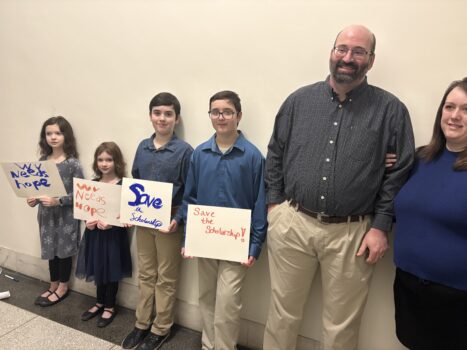
Alice Bonnell of Wood County attended the meeting with her husband and four children who held signs saying “Save the Scholarship” and “WV needs Hope.”
“School choice and the Hope scholarship helps everyone,” Bonnell said in a hallway interview. “And it helps families like mine who need individualized instruction by allowing us to grow in community and helping us to find the resources to best help our students.
“One of my students, because of the Hope Scholarship, likes school now and wants to go to college. Whereas before Hope Scholarship, just getting him to school was very difficult. So we’re very thankful the scholarship is here.”
A lot of school children were both in the hallway and in the committee room. One of them, 10-year-old Leland Findlay of Charleston, described how he benefits from the scholarship program.
“There’s a Hope Scholarship bill that might pass, and it’s horrible,” he said. “It’s gutting all the stuff that you can do with it — you can go to tutoring, you can prep for college. Why would you do that if you are trying to make education better. It’s like you’re trying to do the opposite.
“And also, if something’s working, just keep it the same and it will continue working. Also, I think they just want to kind of sabotage Hope Scholarship so that people will have go to public school.”