
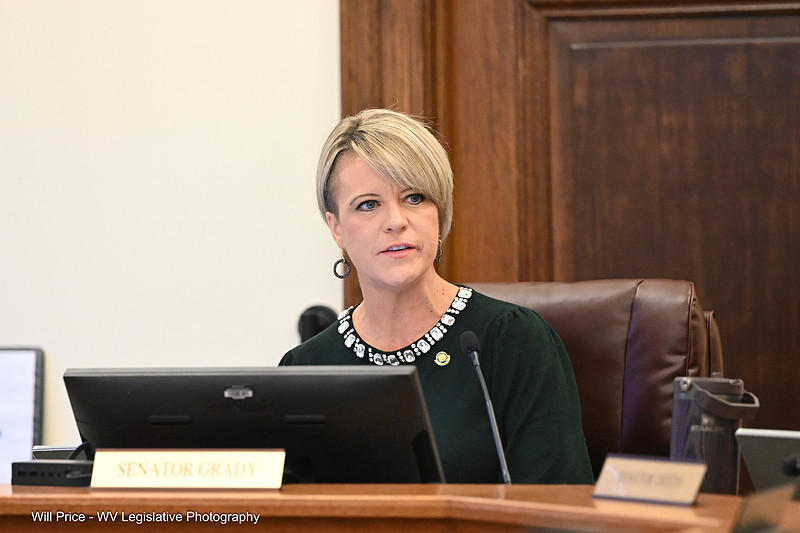
With schools in West Virginia continuing to experience financial stress, the Senate Education Committee is rolling out bills intended to address financial support.
In December, the state school board approved consolidations and closures of more than a dozen schools across six counties. The state also experienced a wave of school consolidations last year.
This is a financial issue, so potential approaches naturally cost money. That will require choices by lawmakers. As with all bills, it’s not clear which of the ones addressing school finances might actually wind up passing.

“We’ve got a lot of requests. The governor has his own requests so we’re looking at the governor has his own requests so we’re still looking at the budget, what’s going to come out,” said Senate Education Chairwoman Amy Nichole Grady, R-Mason, in an interview after today’s committee meeting.
“To me, as a teacher and a person who looks at public education as it should be at the forefront of our discussions, I feel like this is the most important, pressing thing we need to do in this legislative session.”
The committee took up, discussed and advanced two bills today.
SB 801, increasing each school district’s basic foundation program, would increase the professional educator and service personnel ratios by 3 positions per 1,000 students. That would provide more than 720 additional teachers and more than 715 service personnel to county boards of education statewide.
The estimated cost for the salaries, fixed costs, current expense/substitute costs, retirement and PEIA for the additional is expected to be $86,634,763.
“Right now, we have one professional and one service personnel for every 1,000 students. This would increase that number to three,” Grady said.
SB 437, the Fair State Aid Formula Act of 2026, would establish a three-tier special education net enrollment adjustment factor for county boards of education. During this legislative session, officials have described significant increased costs for educating students who sometimes need one-on-one learning or additional nursing support.
The anticipated cost is $45.9 million.
“That’s the big driver. It costs more to educate students who have special needs, and so this would apply a weight to those students — to say it costs more to educate because they require more resources. So this would give counties a little extra funding towards that,” Grady said.
The Senate Education Committee had another related bill on its agenda today but did not get to it yet. That is SB 758, providing extra state aid to school districts for students enrolled in certain schools. The committee is anticipated to circle back to this bill on Thursday.
SB 758 provides extra state aid to school districts for students enrolled in extremely remote schools. It also prohibits a county board from closing an extremely remote school. The estimated cost is $11.7 million.
Of the three potential bills, Grady said, “Hopefully we’ll have a combination of the three or maybe one of them will make it to the finish line.”
The regular legislative session is nearly halfway through, but Grady suggested the cost might be a bigger challenge with the bills.
“They cost a little bit of money, so we want to be sure we have one that everybody is happy with the fiscal impact,” she said.
“And I want to make sure it’s something that moves the needle, that is very helpful, but also has a minimum impact to make sure it passes the Legislature.”

The House of Delegates has also been examining how to relieve strains on school finances. House Education Chairman Joe Statler, speaking on MetroNews Talkline, outlined the number of counties up against mountains of unmet costs.
“You’re looking millions and millions of dollars that we’re seeing in deficits out there,” said Statler, R-Monongalia.