
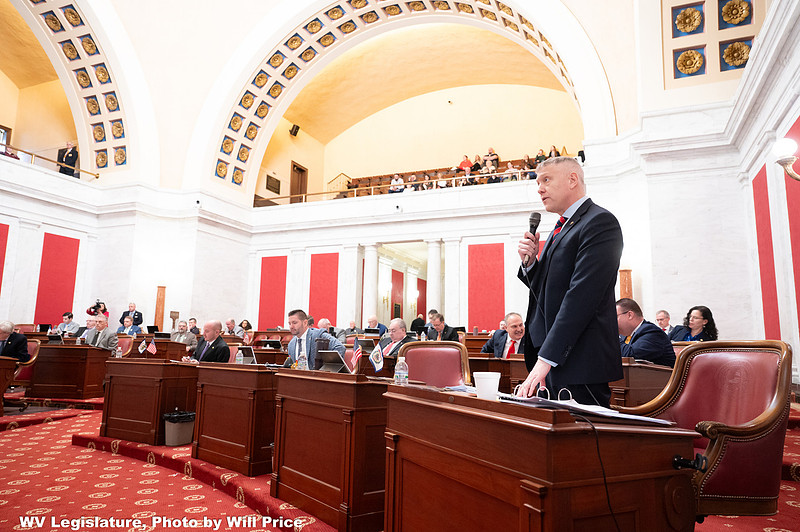
A machine gun bill that popped into the legislative session had a rapid unscheduled disassembly.
 “Unfortunately, time has run out in West Virginia for this year,” said the bill’s lead sponsor, Senator Chris Rose, R-Monongalia.
Compared to a powerful machine gun, the reason the legislation has sagged is a relatively sedate combination of the calendar and process.
The Senate Judiciary Committee discussed and advanced the bill on Monday afternoon. The bill already faced an uphill battle, up against a Wednesday deadline to move bills from one chamber to another — plus the bill had a second reference to another committee, finance.
When bills are passed out of committee, they also need to be received by the full chamber for further action. In this case, the bill was not received by the full Senate during a Monday evening floor session.
“At this point, theoretically, to get the bill out of the Senate in time you would have to suspend constitutional rules, which would take two-thirds of the Senate to do so. So I would say traditionally speaking this bill would be dead at this time,” Rose said following a floor session today.
The Public Defense and Provisioning Act, SB 1071, would establish a new Office of Public Defense managed by the State Police to oversee the sale and distribution of machine guns to eligible residents.
Under the proposal, the state would operate distribution stations at police headquarters and collect fees to fund the program’s administration.
The proposal outlines specific background check requirements and procedures for the legal transfer or return of the firearms.
The Senate Judiciary Committee’s Monday evening meeting, where the bill was discussed and seemingly advanced, ended in confusion — with Chairman Tom Willis calling for the committee to be at ease while he and some other members went into a back room for discussion.
Committee members who remained at the table noted that a quorum no longer seemed to be present and that, for the moment, no one was leading the meeting. One by one several members filed out. Adjournment occurred about 20 minutes later.

Today, Willis said the bill was reported out “and now it’s in the wheels of the Senate, so to speak. So it’s beyond my knowledge or control exactly where it is right now.”
Willis, R-Berkeley, said the bill had been important to him and others.
Whether the bill can be somehow brought back up, he said, “will be a question for the caucus to see what the political will is. Personally, I would like to see it become law. I think it would be nice to return West Virginia to the Second Amendment rights we had before 1986.”

Speaking at the end of today’s floor session, Senator Laura Wakim Chapman said it’s a shame the bill wound up nowhere.
“I’m disappointed,” said Chapman, R-Ohio. “The bill is dead and it was killed without transparency and without consensus.
“The decision was made in the dark, despite the fact that this bill has overwhelming support by this body. This is exactly why the public doesn’t trust politicians.”
At this point, Rose said, supporters of the machine gun bill will likely have to wait until next year.
“As a Second Amendment absolutist, it’s very important to me to see that all of our constitutional rights — especially the Second Amendment — are restored as much as we can,” he said.
Rose said the bill was an attempt to produce a carve-out of federal law, where West Virginia could sell machine guns to interested buyers following background checks and sign-off from federal Alcohol, Tobacco and Firearms.
“One, it restores constitutional rights without violating federal law. And two, there was definitely some interest from gun manufacturers to come to whichever state would pass this bill first. There were a couple of other states looking at it, so there was kind of a race to get it done and unfortunately time has run out in West Virginia for this year,” he said.
“But we’re already whipping the votes for next year and trying to get consensus behind it in both bodies, to address the concerns that came up this year with the bill.”