
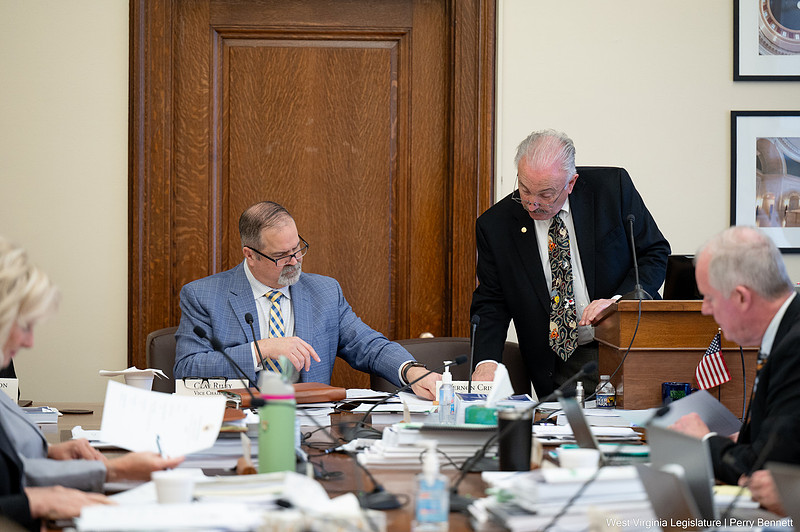
The House of Delegates will consider legislation that will change funding for local school systems, although it wouldn’t kick in until three years from now.

“I support this bill, and I will continue to support this bill,” said Delegate Clay Riley, vice chairman of the House Finance Committee, although he said more work might need to continue on the specifics.
HB 5453 is a significant revision of the current public school funding formula to make it simpler, more transparent and more aligned with student needs — especially special education — while moving away from the current step‑based, multi‑schedule formula.
In December, the state school board approved consolidations and closures of more than a dozen schools across six counties. The state board recently agreed to two more closures in Wayne County. The state also experienced a wave of school consolidations last year.

The House Finance committee discussed and advanced a revised version of the legislation on Friday afternoon.
“We’re trying to make the formula simpler to figure out so you can calculate it based on a per pupil basis rather than on a formula,” said Delegate Joe Ellington, R-Mercer, the lead sponsor of the bill.
Under the most recent version of the bill, the current school funding aid formula would be used for the coming three academic years, until 2029.
Starting with 2029-2030, all county school boards would be funded by block grants of $6,100 per enrolled student. County boards that have fewer than 1,200 enrolled pupils per county would be funded at the minimum level of 1,200 students.
Funding for public charter schools, starting in 2029 and after that, would be $8,600 per student. The minimum student population level wouldn’t apply.
The bill establishes three tiers for additional funding for special needs students. And there are more categories of supplemental funding for areas like transportation, vocational and technical education centers, alternative learning centers and pilot programs.

“While this might not be the perfect solution, it’s a step forward,” said House Education Chairman Joe Statler, R-Monongalia. “And that’s what we’re going to have to do is step forward over the next three years.”
He added, “Let me tell you something, ladies and gentlemen, right now going on in this state, we’re taking down systems because we are not funding them with enough money from the state and the federal to take care of the special education that’s going on.”

Gov. Patrick Morrisey, speaking at a press conference last week, expressed financial caution about additional state support for schools right now.
“You know, those issues didn’t get brought to us at the budget. It’s kind of hard to come up with that now, but I’ll look at everything and I want to make sure we put our kids first,” Morrisey said in response to a question by West Virginia Watch.