
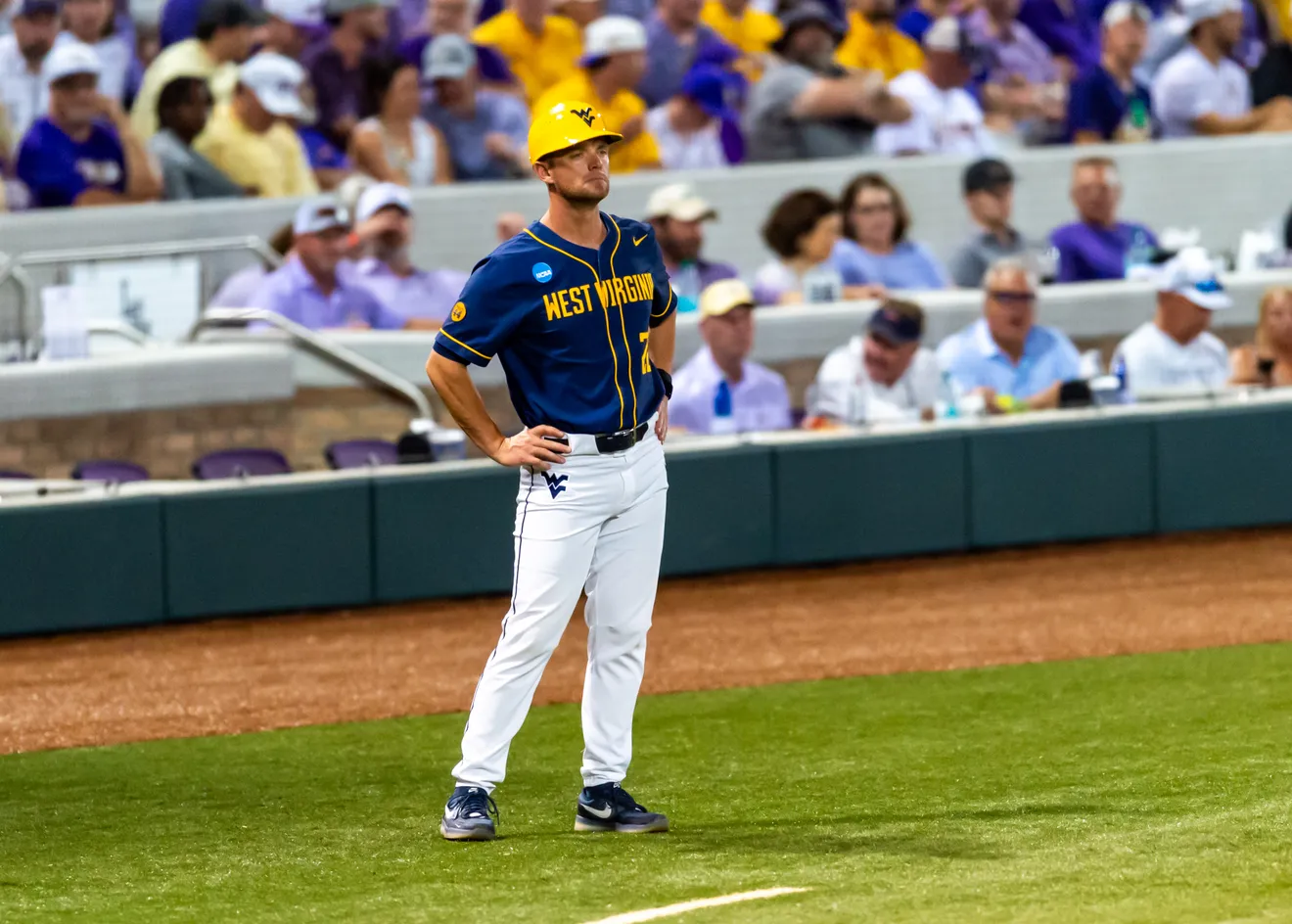
MORGANTOWN, W.Va. — Right-hander Chansen Cole will be the starting pitcher for West Virginia in Friday’s 2026 season opener at Georgia Southern, as announced Monday by second-year Mountaineer head coach Steve Sabins.
Cole will offer the first impression among what Sabins expects to be a group of three high-impact starting pitchers to join the Mountaineers this offseason from the Division II ranks — the others being Dawson Montesa and Ian Korn.
“We’ll see in 15, 20 games, and please tell me if you see more success out of Division II pitchers somewhere else,” Sabins said. “I’m interested in that from a recruiting standpoint. I just don’t think that will be the case. We will probably have the best Division II pitchers in the country.”
It’s a formula that has been kind to WVU each of the last two seasons, but one the Mountaineers expanded on following a 44-win campaign in 2025.
Left-hander Derek Clark made a seamless transition from Division II Northwood University to WVU in 2024, and led the Mountaineers in innings pitched, wins, complete games and strikeouts while registering a 3.23 earned-run average.
It was much the same last season for fellow southpaw Griffin Kirn, a transfer from D-II Quincy University in his hometown of Quincy, Ill. Kirn logged a team-high 17 starts, tossed the team’s only compete game and led the Mountaineers with 99 innings pitched and 103 strikeouts, while recording a 3.36 ERA.
Both Kirn and Clark were All-Big 12 first-team selections.
“In recruiting, when you’re evaluating, you’re very open to the concept that a Division II player can be successful here, because we’ve seen it first and foremost,” Sabins said. “It probably gives us a big leg up in recruiting. Nobody else can really tell the story that the two most successful pitchers in our program over the last two years are unequivocally Griffin Kirn and Derek Clark from a total innings and success standpoint.
“So when you’re recruiting these kids, they like to see the proof. ‘OK, I hear you, and you think I can be a starter at West Virginia. Has anyone ever done it that’s like me?’ And we can say, ‘Yeah, like nobody else in the country.’ We didn’t just attack Division II kids. We recruit everybody and there are a lot of great players. We just happened to probably get the three best Division II pitchers in the country to come to WVU. That’s truly a story.”
Cole is entering his second season of college baseball after starting his career at Newberry College (SC). Opponents hit .220 last season off Cole, who finished 7-5 with a 3.39 ERA while striking out 97 across 87 2/3 innings. Shortly after his freshman season, Cole was pursued by the Mountaineers in the transfer portal and wound up attending a postseason game in the Clemson Regional.
“He’s about a mature and confident of a sophomore player that I’ve ever had,” Sabins said. “Sometimes when a player is coming from a lower level, I feel like they put their toe in the water and figure out if I’m meant to be here and can I do this? He’s come in with such conviction and clarity that he’s capable. He’s been a pleasant surprise.”
Montesa is a right-handed junior with two years of extensive experience at Adelphi College (NY). Across 2024 and 2025, he threw 116 1/3 innings, compiled a 10-7 record and struck out 155 with a 4.02 ERA. Montesa made a major leap in his second season, which he finished 8-1 with a 1.99 ERA and a single-season program record 105 strikeouts over 72 1/3 frames.
“His old school is small and there are not a ton of resources there,” Sabins said. “They don’t have trackman or video. They didn’t even have real velocity. We knew some scouts and agents in that area who had gone to Adelphi. They’re playing in February like we are and they saw the kid throwing 95 in basically a snowstorm. So it was like the legend of Dawson Montesa. It wasn’t documented and there was no real video.
“We recruited him once he got in the transfer portal and we were serious about him, but we still didn’t really know. He went to play summer baseball in the New England Collegiate League and they have some of those resources and that technology. His very first outing, when we were able to see this guy is able to throw 92-95 with some power stuff and good spin, we already knew he was in the zone, competing and healthy.”
From a pitching arsenal perspective, Sabins says Montesa may very well be the top Division II talent brought into Morgantown.
“He’s one of those simple kids that’s really thankful to be here and stupidly talented,” Sabins said. “He has an elite arm and probably more stuff than the other successful Division II pitchers that have been here and gone on to play pro baseball. He actually has more God-given electricity in his arm.”
Korn, also a right-hander, played the last four seasons at nearby Seton Hill University and compiled at 2.84 ERA with 145 strikeouts across 133 1/3 innings.
He was a first-team All-American and the Division II National Pitcher of the Year in 2025, when Korn went 11-2 with a 1.81 ERA and struck out 83 over 84 1/3 frames.
“A strike thrower and competitive,” Sabins said. “He’s going to provide a ton of value to our team.”
Success will be far more difficult to come by for Cole, Montesa and Korn playing major college baseball, but Sabins noted a common theme among the trio that he values heavily — one he believes there’s no substitute for.
“When you’re recruiting transfer portal starting pitching, pitchers that are able to throw 80-100 innings, whether it’s NAIA, Division II, Division III or Division I, it means you’re able to stay healthy, compete and not implode on the mound. I don’t care if you’re facing little leaguers or big leaguers. It doesn’t really matter. There are not that many guys in the country that can actually show up every week and throw seven innings. That’s a great starting point from a recruiting standpoint.”
— — — — —
One player that will not begin the season among WVU’s starting pitching rotation is right-handed junior Chase Meyer, the Mountaineers’ lone selection to the Preseason All-Big team and the squad’s wins leader last year with nine.
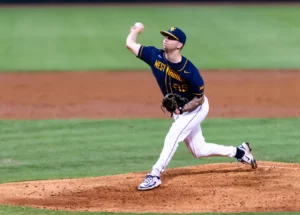
Meyer will begin the season in a relief role as a result of suffering a broken finger on his pitching hand after returning to campus rom Thanksgiving break.
“I hate to use the word behind, but from a scheduling and buildup standpoint, he’s probably three of four weeks behind the rest of the pitching staff,” Sabins said. “But he’s in a great spot. He was up to 97 miles per hour two days ago, so his velocity is there. He’s healthy. Right now, he got up to a max of 30 pitches, so he will be coming out of the bullpen early this season, because he’s probably at a two-inning, maybe three-inning max depending on how efficient he is early on.
“But he’s capable of anything he wants to do. If he competes well and throws strikes, he can be a starter, closer or middle reliever. He’s one of the most talented kids in college baseball.”